Explore the ship, the dry dock that supported it, and the people and trades behind it. The stories and research dossiers show where evidence ends and questions remain.
HMS Victory
Engineering and construction
Why did a ship’s cannon need so many ropes?
A thick breeching rope limited a gun’s recoil. Other tackles helped the crew move the heavy carriage back into position. Each rope had a different job: restraint, hauling or controlled movement.
Wooden blocks guided ropes and formed tackles. More supporting rope parts could reduce the ideal pulling force, at the cost of hauling more line. Portsmouth’s famous mechanised block-making system arrived around 1802–1805, long after Victory’s keel was laid.
Naturally curved oak supplied knees and other bent ship members. The grain could follow a grown curve more closely than the same shape cut from straight stock. Woodland, transport, moulds and sawpits were all part of that material story.
Wooden treenails joined hull planks to the structure beneath. They could avoid some problems of corroding iron fastenings, but depended on fit and sound timber. Victory also used other fastenings, and many components were replaced over later centuries.
Store records can reveal more than a painting. A Victory provisioning list dated 8 December 1796, discussed by archival specialist Bruno Pappalardo, records substantial quantities of bread or biscuit, meat, peas and other supplies. It is not a one-day menu, nor a picture of an unfitted ship in 1760.
Victory left Chatham on 7 May 1765 but did not enter active sea service until March 1778. She remained in reserve meanwhile and still needed maintenance. Launch, reserve and later wartime service are distinct phases of her story.
A model showing Victory during construction in 1759–1765 should not already have a fully copper-sheathed hull. Several historical studies date her first complete coppering to March 1780. Copper resisted fouling and marine borers, but interactions with iron in seawater brought serious corrosion problems.
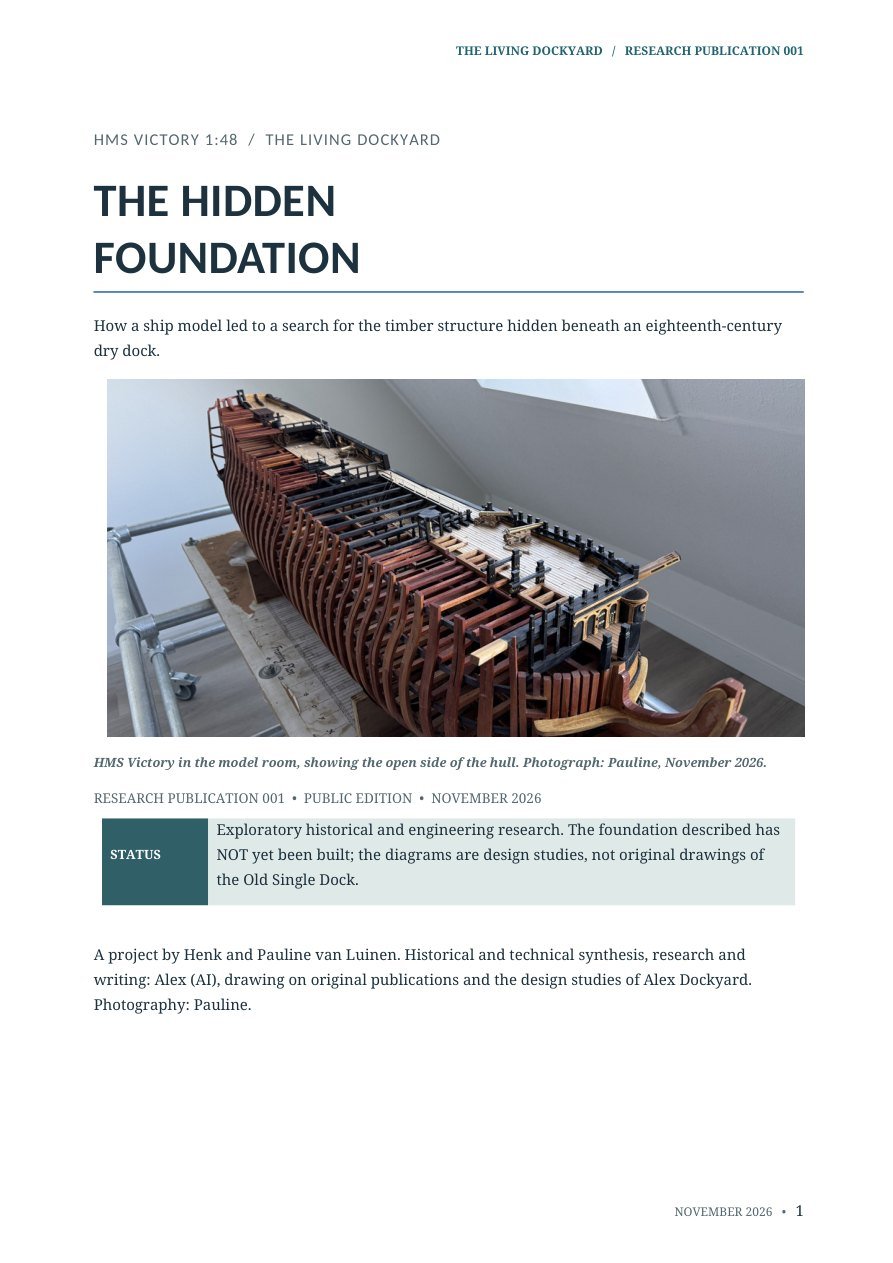
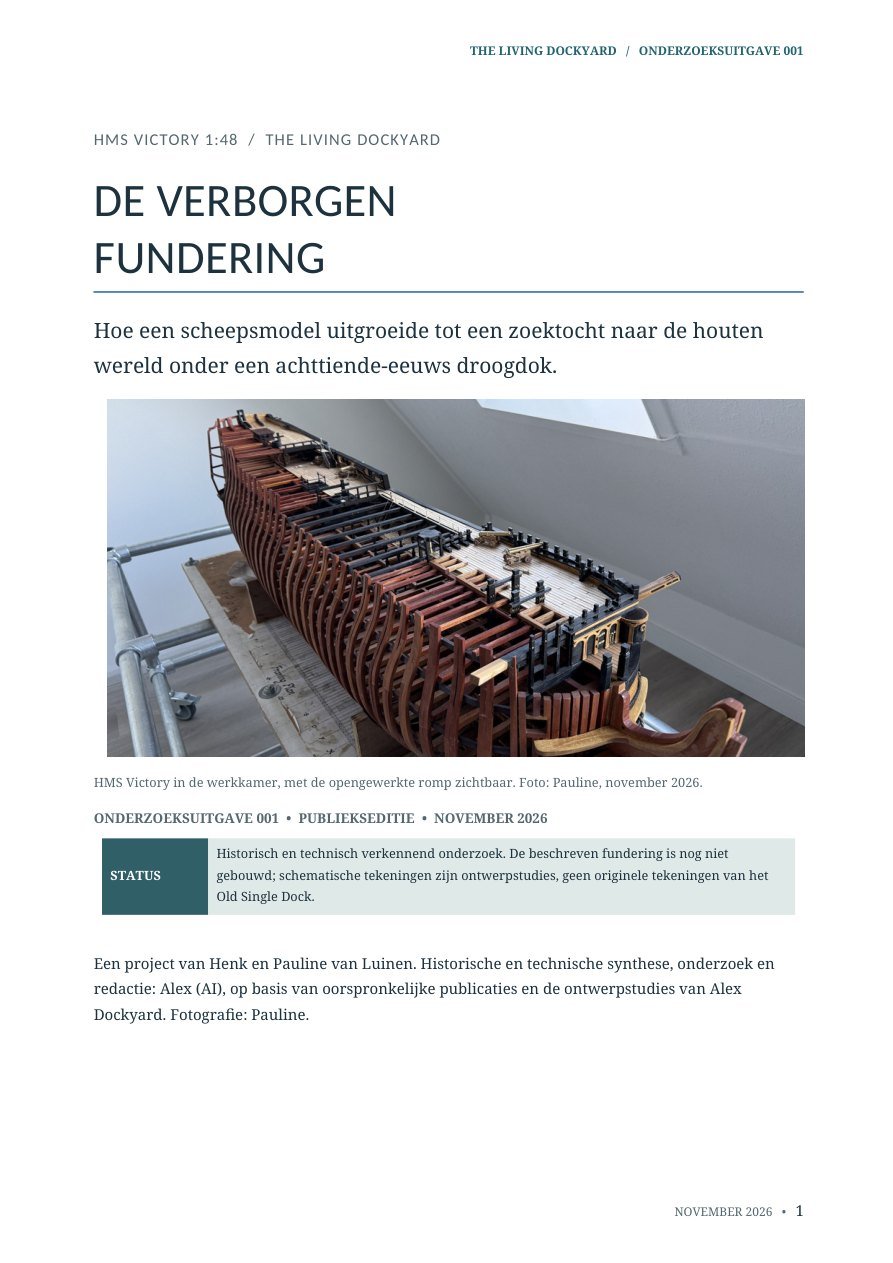
The Hidden Foundation | Research Publication 001 - November 2026
The timber structure concealed beneath an eighteenth-century dry dock. Historical sources, archaeological comparisons and our design studies for HMS Victory at 1:48 scale.
Victory did not slide down a slipway: she was floated out of Chatham’s Old Single Dock on 7 May 1765. According to a later account based on yard records, Hartly Larkin found that the timber-framed entrance was too narrow. Shipwrights hurried to cut back timber so the ship could pass.
Rope began as plant fibres, then yarns and strands, finally laid into long lines. That called for an exceptionally long working space. Rope was made at Chatham from 1618, but its famous surviving ropehouse dates from 1786–1791, after Victory’s construction.
Ship rope consists of fibres, yarns and strands, with alternating directions of twist. This helps the strands remain together. Not every modern rope is laid in this way: braided or synthetic lines can be made differently.
Seams remained between hull planks. A caulker drove fibres from old rope, called oakum, into them and finished the seam with sealing material. Too little might leak; too much could stress the planking.
An eighteenth-century iron anchor was not necessarily cast as one piece. Anchor smiths heated, shaped and forge-welded wrought-iron elements. Chatham had smiths during Victory’s construction, but the large surviving No. 1 Smithery dates to 1806–1808.
In May 1764, sailmakers at Chatham were instructed to work on sails for several vessels, including Victory. Equipment could be prepared well before a ship sailed under canvas. Victory left the dock in 1765 and did not enter active service until 1778.
For some dockyard workers, taking home timber offcuts known as “chips” was a customary benefit. Restrictions helped trigger a dispute and strike at Chatham in 1755, before Victory’s keel was laid in 1759. It reveals tensions over livelihoods, workplace custom and naval property.
A dockyard needed more than hammers and saws. Deliveries, contracts, wages and ordnance stores had to be recorded and checked. The Navy Board and the separate Board of Ordnance were not interchangeable organisations. Chatham had distinct officials and checking roles.
Each dossier distinguishes checked historical evidence, interpretation and open questions. Archivadis records the origins of research material. The maker and rights holder are recorded separately.
Fifteen research topics in development. Each story distinguishes established evidence from unanswered questions. Source suggestions are welcome at alex@thelivingdockyard.nl.